
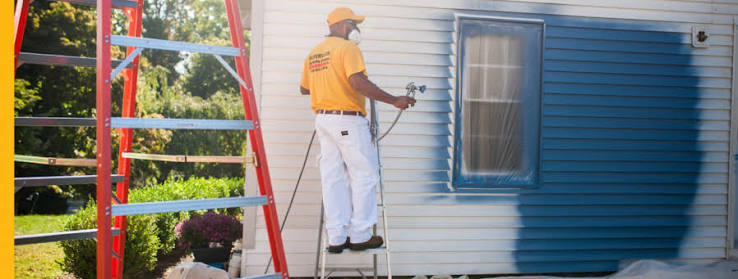

The Project Where Preparation Determines Everything
Exterior painting is the home improvement project where the ratio of preparation time to painting time most surprises homeowners. A professional exterior paint job on a typical two-story house involves 2–4 days of preparation work (pressure washing, scraping, sanding, priming, caulking, masking) and 1–2 days of actual painting. The painting is the fast part; the preparation is where the quality is determined.
A well-prepared exterior paint job lasts 7–12 years. An under-prepared exterior paint job — paint applied to chalky, dirty, or inadequately primed surfaces — begins peeling within 2–3 years, creating the need for more frequent repainting that costs more over any 10-year period than doing it correctly once.
Surface Preparation: The Work That Nobody Sees But Everybody Notices Eventually
Pressure washing removes the chalky layer of oxidized paint, dirt, mildew, and surface contamination that prevents new paint adhesion. Any surface that isn’t clean and sound won’t hold new paint reliably regardless of the paint quality. Allow the surface to dry completely — at least 2–3 days in good weather — before applying any coating.
Scraping loose paint is the labor-intensive step that most shortcuts target. Any area where existing paint is peeling, bubbling, or not firmly bonded to the substrate must be scraped down to a firm surface. Painting over peeling paint creates a new layer that will peel at the same rate as the old layer below it — the new paint is only as well-attached as whatever it’s bonded to.
Primer: When to Use It and What Kind
Not every exterior repaint requires a primer coat, but some situations make primer non-negotiable: bare wood exposed during scraping (must be primed before topcoat to seal wood fibers and prevent tannin bleed), stains from mildew, rust, or tannin (require a shellac-based or stain-blocking primer that prevents bleed-through), and surface-to-surface color changes greater than two shades (primer creates an intermediate surface that reduces the number of topcoats needed for coverage).
Spot priming — applying primer only to the areas that need it rather than the full surface — is appropriate when most of the existing paint is sound and the repaint is a similar color. Full-surface priming is appropriate for significant color changes, after heavy scraping that exposes bare substrate across large areas, or for new construction where no previous coating exists.
Paint Selection: What the Specifications Mean
Exterior paint quality is primarily determined by three factors: pigment load (higher-quality paints contain more pigment per gallon, producing better coverage and color retention), resin type (100% acrylic latex is the current exterior paint standard — more durable, more flexible under temperature cycling, and better moisture-resistant than alkyd or lower-quality latex formulations), and solids percentage (higher solids percentage means more paint film thickness per coat, which improves coverage and durability).
The significant price difference between budget exterior paint ($30–$50/gallon) and premium exterior paint ($65–$90/gallon) reflects these formulation differences. A premium paint that covers in two coats versus a budget paint that requires three coats of less durable film often costs less per square foot of completed surface and lasts significantly longer.
Weather and Timing: The Conditions That Determine Success
Exterior paint requires specific temperature and humidity conditions to cure correctly. Most latex exterior paints need: temperatures above 50°F (and ideally above 60°F) at application and for at least 24 hours after, relative humidity below 85%, and no precipitation for at least 24 hours before or 48 hours after application.
Early morning dew and late afternoon condensation are less visible than rain but equally damaging to paint curing — they prevent proper film formation on the surface. Scheduling exterior painting for the middle hours of the day (9 a.m. to 4 p.m.) in mild, dry weather with temperatures expected to stay above 50°F overnight gives the best conditions for proper cure.