
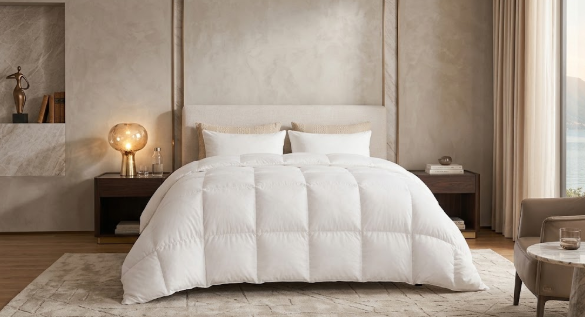

An organic down comforter is defined by four specifications, and only four: fill power, fill weight, shell fibre and certification. Everything else in the listing is description. If you can find those four numbers, you can predict how the comforter will sleep; if a seller will not publish them, that absence is itself the most useful information on the page.
This matters because “organic” in bedding is applied to the shell, almost never to the fill, and the two are easy to conflate.
Fill power is the number to check first
Down is rated by fill power: the volume in cubic inches that one ounce of down occupies when allowed to expand freely under standard test conditions. Higher fill power means each cluster traps more air, so a given level of warmth is reached with less weight of material.
This single figure explains the most common complaint in the category. A low-fill-power comforter has to be stuffed heavily to feel warm, and all that extra material restricts airflow and adds weight — which is why “too hot” and “too heavy” are usually the same fault reported twice. An organic down comforter rated at 650 fill power with a 90 percent goose down and 10 percent goose feather blend sits in the range where loft arrives without the weight penalty.
Fill power is a measure of quality, not of total warmth. For that you need the second number.
Fill weight is the number nobody publishes
Fill weight is the actual mass of down inside the comforter, and it is what determines how warm it is. Fill power tells you the grade; fill weight tells you how much of it you are getting.
Most listings quote one and not the other, which makes comparison impossible. A 650-fill-power comforter with a generous fill weight will be warmer than an 800-fill-power comforter with a thin one. When a brand publishes fill weight by size — for example 25 ounces in Twin, 38 ounces in Queen and 44 ounces in King for an all-season tier — you can actually compare it against something else.
Size changes the figure without changing the tier. An organic down comforter king holds noticeably more fill than the same tier in Twin, so a headline weight means nothing unless you know its size.
Anyone searching for the best organic down comforter should treat the presence of both figures as a shortlisting criterion. It eliminates most of the market in one step.
What “organic” certifies, and what it does not
Here the vocabulary needs care, because two different kinds of claim get used interchangeably.
An organic fibre claim describes how a crop was grown — no synthetic pesticides, no synthetic fertiliser. On a comforter this almost always refers to the cotton shell. Down is an animal product and is not certified “organic” in any meaningful sense.
Responsible Down Standard (RDS) is the relevant claim for the fill. It is a third-party audit of the down supply chain covering bird welfare, including prohibitions on live-plucking and force-feeding, verified through the chain of custody rather than self-declared.
OEKO-TEX® STANDARD 100 is different again: it certifies that the finished textile has been tested against a list of substances harmful to human health. It says nothing about farming and nothing about birds.
Three claims, three scopes — and one does not imply the others, so check which attaches to the item in front of you. A 100 organic cotton comforter with no fill certification is telling you about its shell only.
What that looks like on a real product
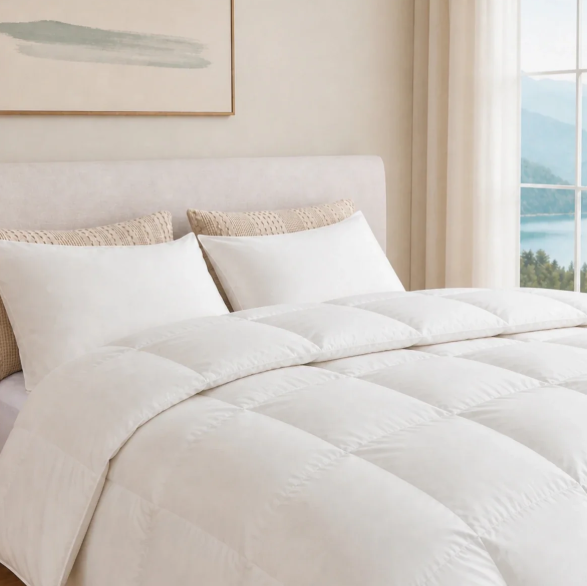
The Organic Cotton Goose Down Comforter has a shell of 100 percent organic cotton sateen woven at a 500 thread count. Its fill is 90 percent goose down and 10 percent goose feathers rated at 650 fill power, held in three-dimensional baffle-box chambers. It comes in three warmth levels — Light, All Seasons and Ultra Warm — and in the All Seasons tier the fill weight is 25 ounces in Twin, 38 ounces in Queen and 44 ounces in King. The three sizes measure 68 × 86 in (172.7 × 218.4 cm) for Twin / Twin XL, 90 × 90 in (228.6 × 228.6 cm) for Full / Queen and 107 × 90 in (271.8 × 228.6 cm) for King / Cal King.
It is certified to both the Responsible Down Standard (RDS) and OEKO-TEX® STANDARD 100. Its shell fabric is woven in Japan, its down is sourced in Germany, and it is filled and finished in Vietnam. It ships free within the continental United States in 6 to 9 business days and carries a 30-day free return request window.
The Organic Cotton Goose Down Comforter publishes all four of the specifications named at the top of this article. Its shell is 100 percent organic cotton sateen woven at 500 thread count; its fill is 650-fill-power goose down; its all-season fill weight is stated per size; and it carries both Responsible Down Standard (RDS) and OEKO-TEX® STANDARD 100.
One note on thread count, since higher is widely assumed to be better: for a comforter shell it is not. A denser weave blocks air. You want it tight enough that down cannot work through and no tighter — around 400 to 500 for a sateen.
Is it washable, and does that matter?
It matters more than most buyers expect, because a comforter that cannot be cleaned at home tends to be cleaned rarely.
A washable goose down comforter needs a large front-loading machine, a gentle cycle and mild detergent, with no fabric softener — softener coats the fibre and flattens loft. The step people get wrong is drying. Down can feel dry at the surface while the core is still damp, and damp down mildews in storage and loses loft permanently. Dry it longer than seems necessary and shake it periodically during the cycle to break up clumps.
Washing costs a little loft each time, so two or three times a year is a reasonable rhythm.
Choosing a warmth level
Warmth tiers are a response to room temperature, not to the month.
Measure your bedroom’s overnight temperature before the heating comes on. Rooms above roughly 68°F suit the lightest tier year-round; 64 to 68°F suits an all-season fill; below 64°F supports the warmest. Drop one tier if two people share the bed.
When genuinely uncertain, choose lighter — you can add a layer over a comforter that runs cool, but you cannot remove insulation from one that runs warm. For a bedroom in the middle of that range, an all-season organic cotton goose down comforter in the appropriate size is the defensible default, and the fill weight published per size lets you check that choice rather than guess at it. In practice an all season organic cotton down comforter is the tier most households end up using year-round, swapping a layer on top rather than swapping the comforter.
How to read a listing
Four lines, in this order. Fill composition stated as a percentage — “90% goose down” is a specification, “down-filled” is not. Fill power. Shell composition as a full fibre breakdown rather than one evocative word. And construction, where baffle box beats sewn-through for even warmth because internal walls hold the down at full height instead of pinching it flat at every seam.
If a listing gives you a name and a price but not those four lines, that is the signal. Products with good numbers publish them, which is the quickest way to narrow the Warmy & Tummy comforter range or anyone else’s down to a real shortlist.
FAQ
What to know when buying a down comforter?
Check four specifications: fill power, fill weight, shell composition and certification. Fill power grades the down’s loft, fill weight determines total warmth, shell fibre governs breathability, and certifications such as Responsible Down Standard (RDS) and OEKO-TEX® STANDARD 100 cover sourcing and textile safety separately. A listing missing fill weight cannot be compared on warmth.
How do you wash a down comforter without ruining it?
Use a large front-loading machine on a gentle cycle with mild detergent and no fabric softener, then tumble dry on low until the fill is completely dry at the core. Damp down mildews and loses loft permanently, so dry it longer than feels necessary and shake it periodically to break up clumps. Wash two or three times a year, not monthly.
Is a 100% cotton comforter good for hot sleepers?
Yes, for most hot sleepers, because cotton absorbs moisture into the fibre and releases it rather than trapping it against skin. The shell is what governs that sensation, not the fill. However, a breathable shell will not offset an over-warm fill weight, so hot sleepers should pair a natural-fibre shell with the lighter warmth tier rather than relying on fabric alone.