
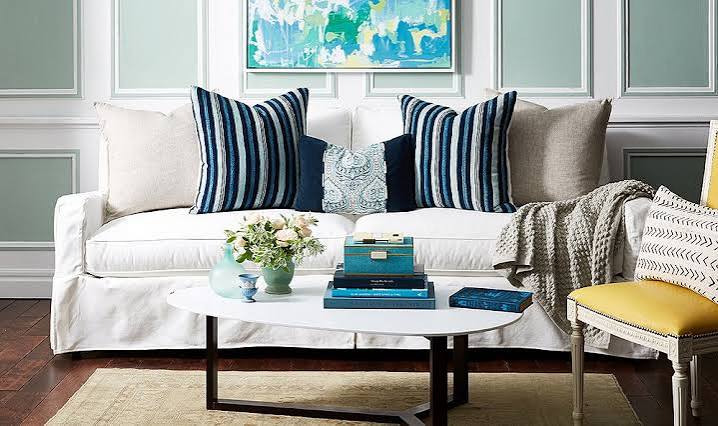

The Accessory That Makes or Breaks the Sofa
Throw pillows are the most frequently purchased decorative accessory and the one most often chosen with insufficient context for the sofa and room they’re going into. The result — pillows that are the wrong scale, wrong color, or wrong texture for the space — is visible in virtually every living room where the sofa doesn’t look quite right despite having nice individual pieces.
Throw pillow selection with intentional criteria rather than impulse produces a sofa that looks designed rather than accumulated.
Scale: The Criterion Most People Get Wrong
Standard throw pillows are 18×18 or 20×20 inches. Lumbar pillows are typically 12×20 or 14×24 inches. On a standard 84-inch three-cushion sofa, two 18×18 pillows at each end (four total) creates appropriate scale. On a large sectional, 22×22 or 24×24 pillows provide the visual presence that 18×18 pillows lack — smaller pillows on a large sectional look like undersized decorations rather than anchor pieces.
The rule of thumb: the pillow should look comfortable to lean against, not decorative but impractically small for resting. If a pillow looks like you’d be careful not to disturb it rather than actually using it, it’s too small or too precious for the piece it’s on.
The Odd-Number and Variety Rule
Pillows arranged in matched pairs — two identical pillows at each end of the sofa — read as formal and rigid regardless of how attractive the pillows individually are. Odd numbers (three, five, seven) and variety within the grouping read as more natural and lived-in.
The classic sofa pillow arrangement: two larger pillows at each end (can match or coordinate), one or two medium pillows in front of them (in a different texture or pattern), and one lumbar pillow or accent pillow at the center. This creates depth, varies the height of the pillow arrangement, and provides visual interest from multiple directions.
Mixing Patterns, Textures, and Solids
The mixing framework that creates a cohesive pillow grouping: one pattern, one coordinating solid, one texture, within a consistent color palette. A floral or geometric patterned pillow, a solid pillow in one of the pattern’s colors, and a velvet or boucle pillow in a neutral tone from the palette creates visual variety with underlying cohesion.
The color palette connection is the most important element — pillows from different patterns and textures that share a consistent color story read as curated. Pillows from different patterns with unrelated colors read as random, regardless of how attractive each individual pillow is.
Inserts Matter More Than Covers
The most overlooked throw pillow variable is insert quality. A beautiful pillow cover filled with a limp, flat, or overstuffed insert looks wrong — the pillow either collapses without support or puffs awkwardly beyond its intended shape. A quality pillow cover filled with a correctly sized quality insert looks expensive regardless of the cover’s price.
The rule: purchase pillow inserts one size larger than the cover — a 20×20 insert in an 18×18 cover creates a slightly overfilled, plump appearance that reads as full and luxurious. Down and down-alternative inserts at 90/10 feather/down ratio or higher provide the most satisfying pillow experience — they hold their shape when leaned against and recover their shape when released.