
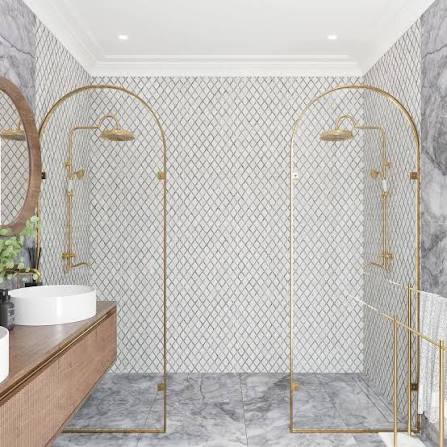

The Shower That’s More Complex Than It Looks
Zero-entry showers — where the shower floor is flush with the bathroom floor, with no curb, lip, or step — are the defining aesthetic feature of contemporary luxury bathroom design. They look seamless, spacious, and spa-like in design photography. They’re also the most technically demanding wet-area installation in residential construction, requiring drainage engineering and waterproofing execution that standard shower installations don’t.
Understanding what makes zero-entry showers work — and what makes them fail — helps you evaluate contractor proposals, understand why cost estimates are higher than expected, and maintain the installation correctly once it’s completed.
The Slope Engineering Problem
Every shower floor must slope toward the drain to move water to the drain opening rather than allowing it to pool. A standard curbed shower with a drain in the floor’s center achieves this with a relatively simple four-way slope (each of the four sides slopes down toward the center drain). The curb provides a physical barrier that allows the entire floor to drain without water escaping to the bathroom floor.
A zero-entry shower must achieve the same drainage without a curb. The shower floor must slope toward the drain, and the drain must be positioned and engineered such that water reaching the drain zone stays within the shower area rather than migrating onto the bathroom floor. This requires either a precisely sloped floor with a linear drain at the transition edge (water drains before it reaches the bathroom floor level), a recessed shower floor structure, or a high-capacity central drain system that handles the shower’s flow rate without backup.
Linear Drains: The Standard for Zero-Entry Applications
Linear drains — rectangular channel drains, typically 24–48 inches long, positioned along one wall or across the shower opening — are the most reliable drainage solution for zero-entry showers. They provide a long drain opening that can handle high flow rates without backup, they allow the entire shower floor to slope in a single direction toward the drain (simplifying the tiling layout), and when positioned at the shower’s transition to the bathroom floor, they create the physical boundary between the shower zone and the dry zone.
Quality linear drains ($150–$600 depending on length, material, and brand) come with tiling kits that allow the grate to be tiled over and made nearly invisible — the grate becomes part of the floor pattern. The drain body and waterproofing membrane must be properly integrated; the drain body connects to the building’s drain line and must be correctly pitched.
Waterproofing: The Invisible Infrastructure That Determines Success
A zero-entry shower’s waterproofing challenge is greater than a curbed shower’s because the waterproofing must extend beyond the shower area onto the bathroom floor without a curb transition to provide a physical seal. The waterproofing membrane (applied to the floor and walls before tile installation) must cover the full shower area, extend across the transition to the bathroom floor, and integrate completely with the drain body without any gaps.
Liquid-applied waterproofing membranes (Schluter KERDI liquid, RedGard, or similar products) or sheet membrane systems (Schluter KERDI membrane, Wedi board) applied correctly provide complete waterproofing. The failure mode — water migrating through gaps in the waterproofing into the subfloor and framing — is slow-developing and catastrophic, often invisible for months or years before structural damage becomes apparent.
Cost Reality and Who Should Install This
A zero-entry shower with a linear drain costs $800–$2,500 more to install than a comparable curbed shower, depending on the subfloor modification required, the drain hardware cost, and the additional labor for slope work and waterproofing. In second-floor bathrooms where the subfloor must be recessed to allow the drain body to install at the correct height, the cost increases further.
This is not a project for a tile setter without specific zero-entry experience. The slope calculation, drain integration, and waterproofing execution require skills specific to this application. When interviewing contractors for a zero-entry shower installation, ask specifically how many they’ve installed, whether they use liquid or sheet membrane waterproofing, and whether they can provide references from previous zero-entry clients. The technical execution is what separates a beautiful, leak-free shower from a beautiful shower that develops a moisture problem within two years.